
In just about 24 hours, the Marlins, Phillies, Nationals and Mets will all be underway (and head to head with each other) officially kicking off the 2010 NL schedule; the Braves join the fun at 4 with a home opener against the Cubs. Before the 162 game marathon begins tomorrow, here is my somewhat detailed breakdown of the division:
1 - Phillies (Expected record: 94-68)
The Phillies are coming off back to back trips to the World Series (including a title in '08) and have only gotten stronger this offseason adding perhaps the best pitcher on the planet in Roy Halladay. Halladay did cost them, in a roundabout way, brief rotation stalwart Cliff Lee, so the Phillies lost out on assembling a potential juggernaut to instead have what should be one of the best two teams in the National League (St. Louis the other)
Key Player: Placido Polanco. Yes, we know all about Ryan Howard and Chase Utley and Roy Halladay and Cole Hamels, but Polanco is coming back to Philly to try to stabilize a position, third base, that has routinely been the Achilles heel for an otherwise potent lineup. If Polanco bring his typical mid-to high .300's OBP with him, the Phillies' everyday lineup will likely feature only one player (Jimmy Rollins) with an OBP below .330. Put another way: filthy.
What Could Go Wrong: Since their back-to-back World Series run, the Phillies have been the healthiest team in baseball by a pretty wide margin. Not only are they the only team to have lost fewer than 1,000 player DL days in that two year stretch, they're below 800. Now, their players aren't preparing their AARP membership applications yet, but Shane Victorino will be the only every day player under 30 in 2010, and he'll just sneak by at 29. The Phillies do have some tough players who have demonstrated a willingness to play through injury, like Chase Utley, but at some point, this remarkably healthy streak has to end. And, while the Phillies are exceptionally top heavy, their depth leaves much to be desired both on the bench and at high levels in the minors; quite simply, among the top 3 teams in the NL East, they are perhaps the worst equipped to internally address a prolonged injury.
Also, don't forget the bullpen. Brad Lidge is still down there, and while they upgraded the rotation considerably, they lost a bullpen ace in Chan Ho Park (I know, it feels just as weird to write it as I'm sure it is to read it) and in some order will have to count on Lidge, Myers and Romero a lot more than I think they would like.
Final Verdict: Unless Howard or Halladay misses substantial time, they're the best team in the division by a pretty sizable margin. This may be their final year of "dominance" as the Marlins and Braves are substantially younger and potentially deeper, but no team in the division can match the Phillies' lineup and, over the course of a regular season, offense wins.
2 - Florida Marlins (Expected record: 88-74, Wild Card winner)
The Marlins locked up Josh Johnson to a 4 year deal, and, somewhat surprisingly kept the entire 2009 team (save Jeremy Hermida and Nick Johnson) together for a front office mandated playoff run in 2010. While they didn't spend to bring in a free agent (every newcomer came in as a non-roster invitee) the core they have, at least on offense, is talented and still blossoming.
Key Player: Dan Uggla. The Marlins' highest paid player in 2010 ($7.8 million) will need to have a strong bounce back year after 2009 saw his average drop precipitously. If the eye he demonstrated in '09 carries over to '10, and the average can improve, Uggla could find himself with the NL All-Stars in Anaheim. More importantly, an improved season from Uggla gives the Marlins middle of the lineup depth behind Hanley Ramirez.
The Marlins 3rd starter (and whoever you are, please stand up) gets an honorable mention, but right now, Chris Volstad, Anibal Sanchez, Nate Robertson are basically the same kind of pitcher and it's not that one needs to step up, really, all of them do. However, if one does blossom into a complimentary 3rd starter to the Johnson-Nolasco dynamic duo, the Marlins really could push the Phillies for the division title.
What Could Go Wrong: Injuries are a concern, but the Marlins do have minor league depth in Mike Stanton and Logan Morrison, plus not too far off Matt Dominguez, and a plethora of second tier guys like Brian Petersen and Scott Cousins. The biggest thing that could go wrong is Ricky Nolasco having another season where he walks no one but gives up a ton of extra base hits. If we see the Nolasco that gets pounded for 7 runs on 9 hits, as we did in much of the first half, this team is in real trouble. There aren't any pitchers in the pipeline ready to step into the rotation, and there are even fewer with the strikeout upside Ricky has (Andrew Miller is the only strikeout pitcher in the system above A, and even then, we know Andrew Miller).
Final Verdict: Uncharacteristically, ownership and the front office are making it known they expect a playoff run in 2010. As constructed, there is talent at just about every position, or waiting for a chance in the minors. Combining that organizational depth with all-world talent like Hanley Ramirez and Josh Johnson makes the Marlins a potentially dangerous team in 2010.
3 - Atlanta Braves (Expected record: 85 -77)
The Braves are the talk of baseball this spring because of the talented youth in their camp, and legendary manager Bobby Cox announcing that this will be his final season on the bench. This combination of potential and nostalgia has made the Braves the sentimental pick for the NL Wild-Card among most writers and analysts.
Key Player: Troy Glaus. Glaus came to Atlanta after basically missing 2009 due to injury, and not only is he expected to rebound, he is expected to anchor the middle of the Braves' lineup as the righty power bat separating Brian McCann and Chipper Jones. Glaus has had to move across the diamond, from third to first, but the hope in Atlanta is that while he may not be familiar with the position, the typically less physically taxing "grind" at first may help keep him fresher in 2010. While his days as a 30 homer masher might be past him, if healthy Glaus should still chip in 20-something homers and a mid 800's OPS. Pretty formidable numbers.
What Could Go Wrong: The Braves are hanging a tremendous amount of expectations on two youngsters: Tommy Hanson and Jason Heyward. For Hanson, who had a marvelous rookie season highlighted by a 1.18 WHIP and 8.2 K/9, the expectation is that he emerges, at 23, as the staff ace, or at least the 1A behind Tim Hudson (who himself has injury concerns). If this Braves team had retained Javy Vazquez, yes, they'd be terrifying, but with Javy now in New York, the Braves are asking a lot out of Hanson with little track record to show it as a certainty.
In Heyward, the Braves have the widely regarded #1 prospect in all of baseball. His lefty swings have drawn comparisons to Fred McGriff, Cliff Floyd and....Hank Aaron. Wait a minute...Hank Aaron; yep, Bobby Cox said so himself. Now, I'm all for seeing the potential in a player, but a 20 year old, who has never hit more than 13 homers or 25 doubles at any minor league level, is expected to come in and be the new Ken Griffey Junior? In the limited AB's I have seen of Heyward, I see a strong hitter for average, but I don't see otherworldly power on a consistent basis. Whether the hyperbole meets reality is somewhat irrelevant: what is important to remember is that the Braves lineup is pretty bland, and much of the runaway hype for them as the presumed wild-card team is based on Heyward arriving with 30 homers in tow; something I just cannot see happening.
Final Verdict: Chipper and Hudson miss some time with injury, Heyward is very good just not other-wordly, and the Braves come up just short in their bid for the playoffs.
4. Washington Nationals (74-88)
The Nationals also had their fair share of spring publicity with phenom Stephen Strasburg tearing through the grapefruit league, many people, myself included, believe Strasburg is the best rotation pitcher the Nationals have, but he's beginning the year at AA.
Key Player: Adam Dunn. The big fella is in a contract year; he's expressed a desire to stay in Washington and the Nationals are taking a wait and see approach, mostly regarding his position switch to first base. Players generally play well when playing for a contract, and Dunn, who just missed extending his 40 homer streak last year when he finished with 39, should have another prodigious power season, driving the Nationals offense behind Ryan Zimmerman.
What Could Go Wrong: Well, they're not really aiming for the playoffs, and they're in year 2 of an aggressive rebuild through the draft (Strasburg) and free agency (Dunn, Ivan Rodriguez). The worst thing that could happen is keeping a non-essential piece of the core past the trade deadline trying to finish closer to .500.
Final Verdict: I like their staff, a lot. By far the deepest rotation in the East, and their second half rotation (Strasburg, John Lannon, Chien Ming Wang, Jason Marquis, Livan Hernandez) is fun to think about, especially when you figure that for '11, Jordan Zimmerman should be back from Tommy John surgery. The future is very bright in Washington, but right now, they're still at least a year away.
5 - New York Mets (72-90)
Disaster probably comes up just a bit short when describing the Mets' 2009; they lost players to injuries, their franchise player (David Wright) openly criticized their new home park (and forgot how to hit for power), their assistant GM took of his shirt and offered to fight a top prospect, their GM accused beat writers of trying to take his job, and Johan Santana had to have surgery. All in all, not what you would call a season you can build off of.
Flash forward to 2010 and Carlos Beltran has had surgery, allegedly, against team wishes, Jose Reyes is out with what may be a thyroid issue (though no one's really talking) and they still play their home games in a ballpark that makes Yellowstone look cozy.
Key Player: David Wright. Baseball's former 'it' boy needs to recapture the power stroke that made him a key player during the Mets short lived renaissance. What's most peculiar about Wright is that his homers dropped, from 33 in '08 to 10 in '09, yet his doubles didn't change, his average didn't improve, yet he struck out considerably more over 120 (140) for the first time in his career. Some may call it an aberration, but to me, it's more than that, his power totals didn't improve on the road (8 all year), which is something you'd expect if the home ballpark is a problem, his doubles didn't improve, which you'd think to be the case if he's hitting balls that come up "just short" and he now really looks like a leadoff hitter when the Mets very desperately need a 3-hole anchor.
What Could Go Wrong: In honor of the Mets' 2009, it could more appropriately reworded as "what won't go wrong?" All kidding aside, before the season even opens, the Mets have lost two of their most important players (Reyes, Beltran) to the DL and their rotation behind Johan Santana has not gotten better. Since Adam Wainwright ended the Mets' 2006 season on a 3-2 curveball, this franchise has been snakebitten and unlucky, and it doesn't look like that's going to change this year.
Final Verdict: If Beltran were healthy, I would love their chances, but he isn't, and given the nature of his injury (hip labrum) and his style of play, you have to wonder if he'll ever be the same player again. Beyond that, Santana is spectacular, newcomer Jason Bay is solid, but there is so much bad hanging over this team, you really can't understate that. A slow start likely causes a top down clean-out, and with that kind of turnover, it's hard to imagine anyone on the team looking forward to the dog days of August as nothing more than the dysfunctional black sheep to the cross town Yankees.
Showing posts with label 2010 Preview. Show all posts
Showing posts with label 2010 Preview. Show all posts
Sunday, April 4, 2010


Friday, March 12, 2010
2010 Preview: The Infield
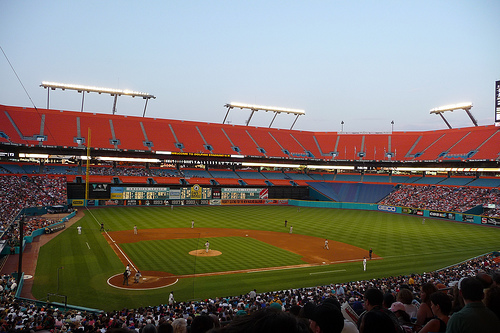
Entering the 2010 season, the Marlins have all but one of their starting positions filled, a degree of certainty they haven't had since 2005. With the roster that secure, it's never too early to take a peek towards what 2010 may have in store for the team.
Catcher
The starter: John Baker will be entering his second full year as a Marlins starter (he took over in 2008 after the team finally pulled the plug on failed project Mike Rabelo). The former Moneyball star has proven several things with a full major league season: he can walk, he can hit with runners in scoring position, and he cannot, or rather, will not be allowed to, hit lefties.
Baker's .349 OBP was 4th on the team among players with at least 100 games played, which should not be a tremendous surprise given he came from the Oakland A's system, who preach OBP above all. What was a surprise was how well he hit with runners in scoring position (.421 OBP, 36 RBI, .878 OPS).
He also demonstrated an ability to hit all over the order, spending time in the 2-hole and the 8 spot, with no noticeable drop-off in production for either spot (.367 OBP batting 8th compared with a .368 OBP batting 2nd). This kind of versatility is especially important to a National League team as "turning the lineup over," an expression referring to getting the pitcher to hit in the middle of an inning rather than to lead off an inning, is important to team's with as top-heavy a lineup as the Marlins. The home-run power never developed (9 HR's in 2009), but he did hit plenty of doubles, and it appears that Sun Life Stadium was a cause for some of this power shortage as he hit only 3 homers at home to 6 on the road.
Lastly, Baker logged only 35 at-bats against south-paws, demonstrating that the Marlins would rather let him play only against right-handed starters, and with an in-house option like Ronny Paulino, it's hard to blame them. Still, for Baker to take the next step and become an essential part of the Marlins core going forward, he's going to have to be given the chance to see if he is more than a platoon player.
Look for Baker's 2010 to be filled with walks, doubles and plenty of productive AB's.
The Backup: Ronny Paulino has made a 4 year career of just killing left-handed pitching. He continued that in 2009 with a .458 slugging percentage and a .801 OPS against lefties. In 2010, look for the platoon to continue with Paulino getting the bulk of the playing time against lefty starters.
What could be improved: Defense, defense, defense. Neither Baker nor Paulino showed exceptional catch-and-throw skills behind the plate (Baker threw out 20% of attempted base-stealers and Paulino threw out 30%). Despite Baker's 5 past-balls to Paulino's 3, Baker seemed to be far better at blocking balls in the dirt though both have room for improvement. Still, the catcher's position is very difficult to play and even more difficult to find offensive talent. If their bats continue to thrive (and all signs point to that being the case) defensive short-comings can be overlooked for a strong bat.
The Final Verdict: Offense seems to be the theme here, and that will be a recurring theme throughout the team. The Baker / Paulino platoon should be incredibly productive, especially compared with other National League catchers. Behind Yadier Molina and Brian McCann, the Marlins might have the best catching situation in the NL.
3rd Base
The Starter: Jorge Cantu figures to be the starter at 3rd, but a bad spring from the first base competitors could shift him back to 1st with Wes Helms or possibly rule V pickup Jorge Jiminez taking over as the everyday 3B. Cantu's two seasons with the Marlins were incredibly surprising and productive. He followed up a 29 homer, .808 OPS 2008 with a strong 2009 where he improved his OBP significantly despite battling nagging wrist and hand problems. He has also emerged as a great situational hitter for the team as he thrived with runners in scoring position, knocking in 83 RBI and posting a .440 slugging percentage. Figuring to be the cleanup hitter behind Hanley Ramirez, Cantu should continue to have plenty of chances with runners in scoring position and that should be great news for his 2010 outlooks.
Cantu has also carved out quite a niche at home, posting significantly better numbers at home than on the road (.848 home OPS to .725 road OPS). While there is nothing wrong with thriving at home, a higher degree of consistency is hoped for, if not expected, from a middle of the lineup hitter.
The backup: Wes Helms really only factors into the discussion at 3rd base in the event of injury or ineffectiveness. He's one pinch hit away from the Marlins' all-time lead in that category, and he's been a spectacular bench option, and he should remain there. We'll delve deeper into Helms when we preview the bench.
What could be improved: Defense, defense, defense (sound familiar?). Cantu's not a sieve at 3B, but he's close. Originally a second-baseman with Tampa, the Marlins moved him to 3rd out of necessity in 2008 when trying to find a replacement for Miguel Cabrera. Cantu's bat can play at an infield corner position, but his glove needs tremendous work. Consistency is really a key here. Cantu has been far from a disappointment, but he is prone to stretches of disappearing, and he struggles on the road. He posted a .231 average in August and followed it up with a .337 average for the month of September. When your job is to be Hanley Ramirez' lineup protection, it's important to not disappear for weeks at a time.
The Final Verdict: Cantu's production cannot be questioned, just his glove. As a 3B option on a budget, it's hard to find better. He's not the ideal cleanup hitter, but he's probably the best in-house option to bat behind Hanley.
Short-Stop
The Starter: Hanley Ramirez is not just the best player on the Marlins, but possibly the best player in baseball behind Albert Pujols. His 2010 was remarkable. He won the first batting title in Marlins history with a .342 average and he finished second to Pujols in MVP voting. His 106 RBI led the team, as did his .410 on base-percentage and .543 slugging percentage. Suffice to say, as goes Hanley, so goes the team.
There is not much to say about Hanley that hasn't been said time and again. People said he was to immature to play at the major league level, yet he wins the MVP award, critics said he couldn't hit in the 3-hole, yet he wins the batting title while driving in 106 runs, critics said he would have to move from the short-stop position because of defensive short-comings so he posts the 3rd highest fielding percentage among National League short-stops while cutting his errors in half from a season before. Quite honestly, all bets are off with Hanley. He could hit .400, he could hit for the cycle and he could hit 4 home-runs in one game. There is no better embodiment of a 5-tool talent now that he's removed all doubt about his ability to play short-stop long term.
The backup: Emilio Bonifacio figures into the picture only when Hanley needs a day off.
What could be improved: A year ago, you would have said defense, two years ago, you would have said defense, hitting the outside pitch behind in the count and hitting with runners on, now...I'm not even sure. Maybe you'd like to see a few more homers out of Hanley, maybe you want to see him hit .400. The only area Hanley still does struggle is on challenge fastballs. Pitchers can climb the ladder on him, especially when they're ahead in the count. Maybe he can work on that.
Final Verdict: The team's best player, the best 5 tool talent in baseball and a perennial MVP candidate. One of the few players in baseball truly worth the price of admission.
Second Base
The Starter: Dan Uggla begins a surprising 5th season with the Marlins. I say surprising because, well, not even he expected to be back after trade talk became so loud it seemed he should have been house shopping in San Francisco. The two time all-star 2B finds himself back in Miami as a key cog in a very powerful Marlins lineup. His 31 homers led the team in 2009 and his power production will go a long way towards dictating how competitive the Marlins are in 2010.
In 2009 he demonstrated an ability to walk at an unexpectedly high rate, and he posted the second highest OBP of his career despite a career low batting average. If he can return to his .260 career average, do not be surprised to see Uggla OBP close to .400 in 2010, and given his prodigious power, that is a scary proposition. You can pencil Uggla in for around 30 homers and 30 doubles.
The Backup: Emilio Bonifacio is a natural second baseman and could see some time at this position in the event of an injury or trade.
Needs Improvement: Uggla's defense has always been a sore spot, and his performance in the 2008 All-Star Game hammered that point home on a national stage. Uggla's glove is not as bad as people like to think it is, his range, especially to his left, is his biggest problem, not his ability to make the routine plays.
The Final Verdict: For the first time in a long time, the Marlins kept a luxury item like Uggla rather than trade him. Keeping him around not only gives the 2010 Marlins a legitimate shot at the post-season, but also buys a tremendous amount of credibility back with front offices around the league. His 30 something homers, 30 something doubles and middle of the lineup presence make Uggla the second most important position player (behind Hanley) for the Marlins' 2010 season.
First Base
Going into the spring, the first base job was declared an open battle between prospects Gaby Sanchez and Logan Morrison. A little under 2 weeks in, we here at First Place Fish are prepared to call that race in favor of Gaby Sanchez. Morrison's had a snake-bitten spring. By all indications, when he hits it hard, it's right at someone. Sanchez also has the added benefit of being in the big leagues in 2008 and 2009, so the Marlins are very much in a "show me" mode with Gaby. The Marlins are rumored to be interested in pursuing former Marlin Mike Lowell, so while it appears that Logan, at least for the time, is out, that is not to assume Gaby is in.
The Starter: It looks like it's going to be Gaby Sanchez, but we're going to have to hold off on assuming he'll be here for any extended period of time. Long term, the position belongs to Morrison, and even short term, it appears the Marlins are also exploring external options. Fox Sports' Ken Rosenthal reported we kicked the tires on Carlos Delgado before his most recent hip surgery, and the Sun-Sentinel is reporting we've had discussions about Mike Lowell. Clearly, Gaby does not have the Marlins front office fully behind him.
As a pro, Gaby figures to be a doubles hitter as his home-run power never developed in the minors. His glove is also a real cause for concern as the Marlins have floated him around the field before finally settling on him at first-base.
Beyond that, there's really not much to say about Sanchez other than he'll find a way to hit around 18 homers if he gets 400 AB's and held to the standards of a first-baseman, that's fringe production at best.
The backup: Wes Helms could get prolonged playing time here if Sanchez struggles, and journey-man Mike Lamb could end up winning the lefty bat off the bench spot which, at least in theory, could make him the true backup.
The Final Verdict:This position is the most unsettled on the roster, at least in the short-term. Whenever he arrives, Morrison figures to be no less than a 5 year starter for the Marlins, but until that time, the job figures to belong to Sanchez, or an as of yet unidentified player from outside the organization. An end of the spring trade would not be surprising, but I would expect the Marlins to break camp with Sanchez as the starter. In the event of a playoff push, first base is likely the first trade target.
Subscribe to:
Posts (Atom)

 Posts
Posts

